
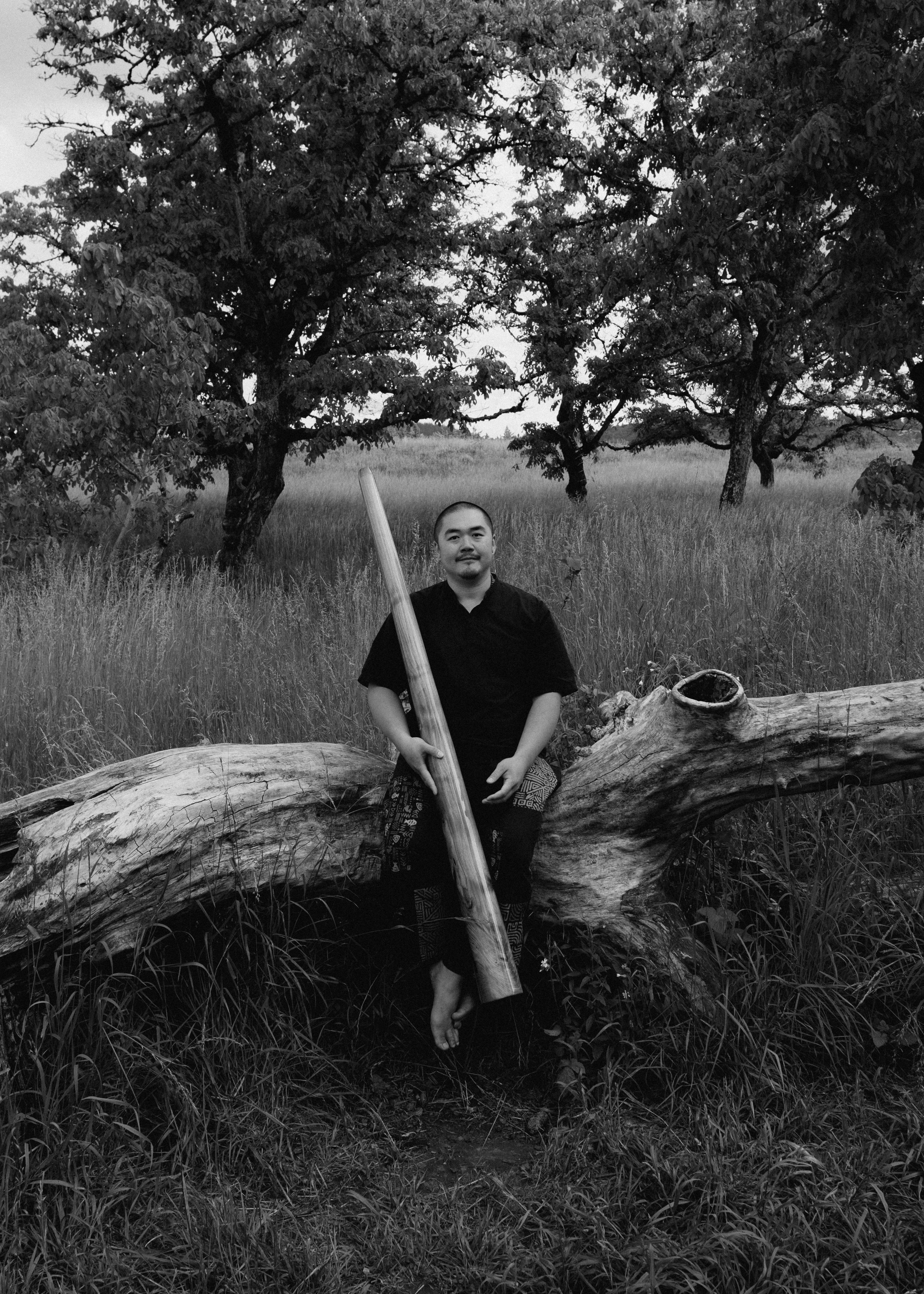
He grew up in Singapore moving to the beat of music before he had words for it. From childhood, he noticed something quietly strange — the people around him didn't seem to know how to breathe. Shallow, hurried, as though the body were an inconvenience rather than a home. That noticing stayed with him like a question he couldn't yet form.
His love of music found expression through the guitar, which led to film, sound, and video — and eventually a career in the intense world of events and concert production. He was immersed in sound as craft, as profession, as output. Something in him knew the difference between that and what he was actually looking for.
He discovered freediving — and in the practice of breath retention and release, something ancient in him recognized itself. He found Traditional Thai Bodywork, and felt the deep somatic intelligence that lived in the body when breath and presence finally aligned. He was assembling something, piece by piece, without yet knowing what it was.
He left the media industry before burnout arrived. An early, quiet act of self-trust. India first — the aliveness pressing in from every direction. Something cracked. Pinpricks of presence, beginning to shine through.
Then New Zealand — six months on a motorcycle, riding into the unknown. It was there that he encountered the didgeridoo — ancient, ceremonial, breath-driven — and felt it pull him in with an immediacy that went far beyond curiosity. It was not an instrument he discovered. It was a recognition.
In New Zealand he sat his first 10-day Vipassana. Day seven — a bliss state arose, radiating from within. Nothing performed. Nothing added. He had no framework for it. He dove into the Buddhist sutras, searching for language for what had been pointed at.
On the seventh day of his third Vipassana, it happened completely — a clear dissolution into source. When he returned to his body he was laughing and crying simultaneously, from the sheer joy of recognizing what had always been there. All those words. All those scriptures. All that practice. Pointing at something that had never moved.
A vow arose. Not chosen. Not constructed. How can this life be of service to this?
With the dissolution came another pull — to take vows, to live as a monk. He gave away his possessions and went searching for the right tradition. Thai forest monasteries first. Then a Korean Zen center, where he arrived for his first 100-day retreat and felt immediately at home.
He stayed — serving the community, chanting, sitting, training on the path to becoming a novice monk. Six 100-day retreats. Three years of intense practice.
In time, even the desire to ordain fell away.
When his time was complete, he walked out. The ox-herder returning to the marketplace.
That walking led him to Seyeong.